
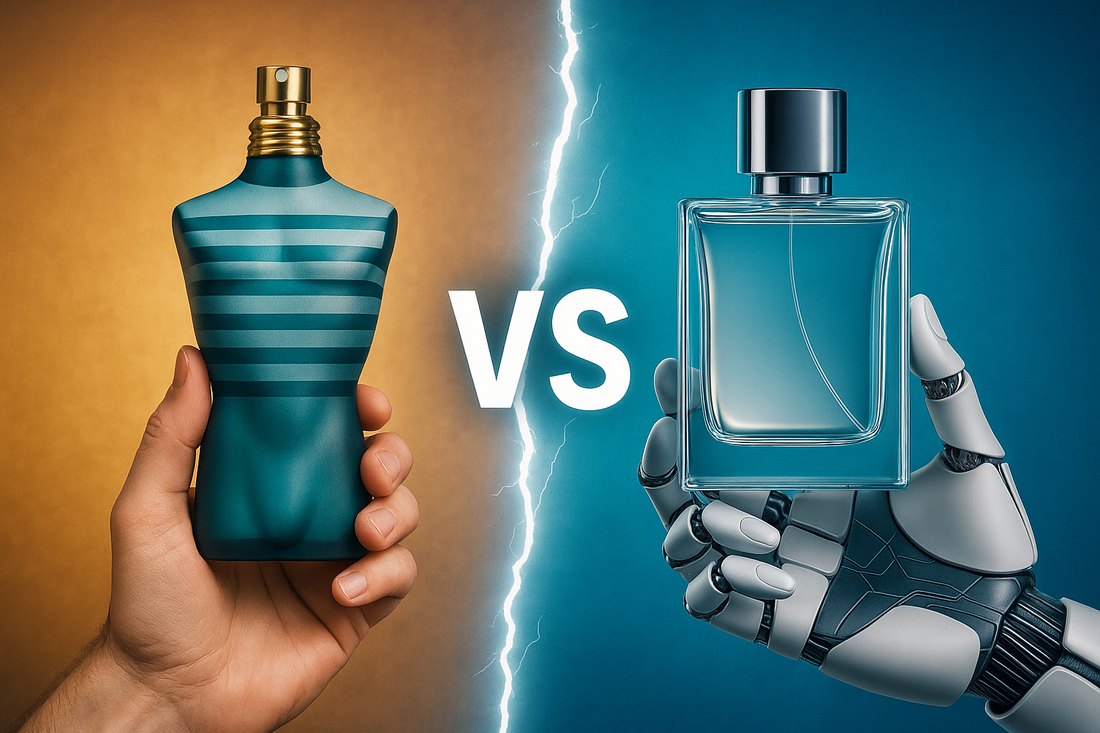
1. Introduction – Perfumes and AI: Duel or Encounter?
In recent years, we've heard a lot about artificial intelligence, algorithms, and digital innovation. From the world of music to the art world, it seems AI is poised to revolutionize everything. And what about perfumery?
Here too, among high-tech startups and historic giants like Givaudan and L'Oréal, AI is entering through the front door: software-generated formulas, "tailor-made" perfumes generated in minutes, and digital tools that promise to unmask fakes with a click are being tested.
But what really changes for those who love perfume? Are we facing a genuine revolution, or simply a passing fad?
And above all: in the duel between the wonders of AI and the charm of vintage, who really wins?
Why everyone is talking about AI in perfumery today
AI is no longer just science fiction or conference topics. Today, anyone can stumble upon advertising campaigns promising "perfume created for you by artificial intelligence," online tools that decipher batch code in seconds, or blogs listing "perfumes created by algorithms."
For those who collect or truly love the history of perfume, this revolution generates two opposing reactions: on the one hand, curiosity for the new, on the other, the skepticism of those who know that certain emotions—the allure of time, memory, rarity—cannot be imitated with data.
- The true potential (and limits) of AI in perfumery
- Where technology makes the difference and where vintage remains unsurpassed
- Real experiences, true cases, curiosities from the world of collectors
- A transparent comparison: hype or reality?
- And finally, let's talk about the community: which side are you on?
2. The Superpowers of Artificial Intelligence in Perfumery
AI has brought a breath of fresh air to a sector that has always existed between art, alchemy, and science. But how has artificial intelligence already changed (or is changing) the world of perfumes?
What can AI (really) do in perfumery today?
- Analyze millions of formulas and trends: specialized algorithms “map” ingredients, historical recipes, audience preferences, and sales performance, identifying patterns and new opportunities that would be impossible to capture manually.
- Creating new fragrances in record time: software developed by giants like Givaudan (“Carto”) and IBM (“Philyra”) can propose dozens of innovative combinations in just a few hours, accelerating research and development that once took months.
- Personalizing perfume to your taste: AI allows brands and startups to collect sensory and behavioral data through online tests, matching olfactory profiles to a customer's tastes, habits, and even emotions.
- Analyze big data and anticipate trends: AI "reads" social media, analyzes reviews, and listens to the market in real time to predict which notes will be trending or where to focus next collections.
Real-world examples of AI in perfumery
- Givaudan Carto: a digital assistant for professional noses, capable of suggesting recipes and proportions based on historical data and market preferences.
- IBM Philyra: an algorithm capable of creating perfumes optimized for specific market targets, taking into account cultural habits and local trends.
- Symrise: Uses AI to analyze consumer reactions, online trends, and new ingredients, speeding up the development of new products.
- Innovative startups (e.g., Scentmate, EveryHuman, Ninu): they use AI to offer tailor-made perfumes, advanced sensory quizzes, smart packaging, and “phygital” experiences.
- Analysis of global data and trends
- Quickly create olfactory combinations
- Large-scale customized proposals
- Experimentation without limits (and without wasting raw materials)
AI can create and suggest, but can it excite? In the next chapter, we'll discover what makes vintage an unbeatable competitor.
Spoiler: History and magic are not planned.
3. The Soul of Vintage: Why the Past Resists
There's a question no algorithm can ever answer: what makes a vintage perfume truly unique?
As artificial intelligence crunches data and produces unprecedented combinations, the world of collectors and enthusiasts continues to grow. Why?
Emotion, history and authenticity
- Each vintage bottle tells a true story: the journey of a perfume that has spanned eras, fashions, and generations.
- The imperfections of artisanal production, the invisible signature of a master perfumer, small defects that make it unrepeatable.
- Personal memories, handed down gestures, emotions linked to an era that no software can truly reconstruct.
Rarity and collectible value
- Some fragrances no longer exist: banned formulas, ingredients now prohibited, unique batches that have become true treasure troves.
- The value is not just material: it is the search itself, the wait to find “that bottle,” the satisfaction of owning a piece of history.
- Collecting vintage means joining a community of experts, exchanging information, and sharing authentic passion.
If you want to learn more about the differences between vintage perfumes and niche perfumes , you can find a detailed comparison here.
The irreplaceable role of the human nose
- The greatest masterpieces are born from intuitions, happy mistakes, artisanal genius – not from statistical calculations.
- The perfumer interprets emotions, atmospheres, and stories. AI can suggest, but humans choose and refine.
- Modern reformulations, often driven by IFRA data and regulations, rarely match the complexity of historical versions.
To better understand the topic, you can read the complete guide on reformulations, IFRA and original versions .
- Unrepeatable emotion, linked to time and memory
- Rarity and absolute uniqueness (no batch is identical to another)
- The allure of imperfection and “true” history
- Priceless cultural and emotional value
For those who love perfume, AI can offer a lot. But vintage offers something no algorithm can clone: the feeling of being part of a legend.
4. AI vs. Vintage: Field Tests
When theory and passion meet, the question is only one: who really wins, the algorithm or the legend?
To answer, it's not enough to talk about technology or nostalgia: you need to try, smell, compare, discuss. And the answer... often surprises.
AI-created perfumes versus icons of the past
In recent years, the first perfumes "designed" by artificial intelligence have hit the market. They are often modern, intelligent, and perfectly balanced.
But let's put them next to an 80s Guerlain, a vintage Chanel, a masterpiece that is no longer in production:
- The AI's precision is unquestionable, every deal is calculated, no excesses.
- Vintage , on the other hand, surprises with its depth, evolution on the skin, notes that tell stories (and sometimes imperfections that become poetry).
Personalization: Does AI really “know you”?
AI makes you fill out tests, evaluates your tastes, selects tailor-made ingredients.
Result: a “tailor-made” perfume, perfect… in theory.
But anyone who has tried a "right" vintage knows that certain emotions are not chosen, they find you:
- The scent of an era, of a home, of a loved one.
- The magic of a forgotten batch, rediscovered by chance.
Shopping experience: emotion, ritual, anticipation
Buying an AI-driven perfume is often a digital, rapid, tailor-made process.
Vintage is research, waiting, risk, the joy of a perfect bottle or a box worn by time.
- AI reduces errors, vintage multiplies stories.
- AI gives comfort, vintage gives pathos .
“I tried a fragrance 'custom-made' with AI. Excellent, no complaints there. But when I found an old, still-sealed YSL Kouros, it was like traveling back in time: pure emotion, something no algorithm could ever give me.”
Who wins the duel?
There is no universal answer:
- AI brings accessibility, experimentation, personalization.
- Vintage wins for history, emotion, charm, value.
5. Risks, Limits, and "Fakes": When AI Isn't Enough
The creative limits of automation
- Algorithms generate infinite combinations, but true inspiration, brilliant intuition, the “signature” of a nose are still on another planet.
- AI can suggest, but never dream. It can copy, but never dare, like those who invented, for example, the first chypres, aldehydes, or the "dirty" notes so beloved in vintage perfumes.
- The risk? An olfactory homogenization: fragrances that all look alike, perfect but soulless.
The Problem of Fakes: AI and Human Detectives
- AI is now used to authenticate products, scan codes, and detect suspicious patterns. But the counterfeit market is always one step ahead:
- Cloned batch codes, sophisticated packaging, sophisticated scams that only the expert eye (and nose) can truly unmask.
- Vintage collectors and sellers know that absolute certainty doesn't exist: often it takes experience, comparisons, community, and – if you want – reliable tools like batch code decoding.
An example? VIPER is a next-generation software developed by true vintage perfume experts, who share their knowledge both automatically and (when needed) with manual consultation.
A medium that enhances human experience rather than replacing it, the exact opposite of the cold and impersonal tools in fashion today.
Privacy, transparency, ethics
- A “bespoke” perfume created by AI is based on a huge amount of personal data: preferences, habits, even sensitive information.
- The question is: how much are we really willing to share? Who controls how this data is used?
- The risk of biased algorithms (digital prejudice): standardized scents, limited choices, less authentic experiences.
- Direct experience, the comparison between enthusiasts, the art of recognizing details invisible to any machine.
- The thrill of smelling a real piece of history, impossible to replicate artificially.
Beyond AI: Human Value
Ultimately, AI can help, speed things up, and offer additional tools. But in the world of perfume—especially for vintage perfumes—shared knowledge, experience, and passion remain essential.
Innovation is useful, but it can never replace the magic of time and the eye of someone who truly loves.
6. Towards the Future: Summary, Reflections and Community
Integration is possible: AI as an ally, not an enemy
- Artificial intelligence can speed up, suggest, and offer new creative and market opportunities.
- Vintage perfumes and the culture of collecting remind us that every bottle is a story, an emotion, a journey through time.
- More and more brands are learning to integrate digital tools with craftsmanship and authentic storytelling.
The future is hybrid: innovate without forgetting
- Innovation will be truly useful only if it can enhance memory, manual dexterity, and the pleasure of discovery.
- Collectors today have more tools, but the real difference is always made by experience, study and curiosity.
Community: A word from the enthusiasts
Are you an AI team or a vintage team?
Perfumery thrives on dialogue, discussion, and passion.
We invite anyone with a story, a doubt, a discovery to comment, share their experience, or ask questions.
Because, as in any art, value grows when it is shared.
Tell us in the comments: have you ever tried an AI-created perfume? Have you ever experienced the thrill of finding a rare vintage perfume?
What do you think is the true future of perfumery?
7. FAQ – Real Questions from Collectors (and More)
-
1. Do AI-created perfumes really have something more than vintage classics?
Generally not: AI offers innovation, speed, and a certain coherence, but it rarely achieves the emotional depth, evolution, and allure of historic formulas. Vintage masterpieces are often the result of intuition, technical limitations, ingredients now unobtainable, and unrepeatable stories. -
2. Can AI help identify fake or authentic perfume?
Artificial intelligence can be useful for analyzing patterns, batch codes, and technical details, but in the world of vintage, human judgment remains essential. The experience of those who truly understand production variations, materials, and defects—authentic or otherwise—still makes the difference. -
3. Is the data I provide to have a “tailor-made” perfume made using AI safe?
It depends on the company's credibility: many collect personal data, habits, and preferences. It's always a good idea to familiarize yourself with their privacy policies and how they use your information, avoiding providing sensitive details unless necessary. -
4. Do modern AI-created perfumes have collectible value?
Not at the moment: they're often products designed for the mass market or for experimentation. True collectible value remains anchored in vintage pieces, limited editions, and the unique stories behind each bottle. -
5. Will technology end up “killing” vintage?
Quite the opposite: innovation offers new tools, but vintage remains sought-after precisely for its uniqueness and what cannot be replicated. Indeed, technology can help protect, study, and further enhance the fragrances of the past. -
6. Can a “digital” collector become a true vintage expert with the help of technology alone?
Technology can accelerate learning, offer data and tools, but field experience, interaction with other enthusiasts, practical knowledge, and passion still make (and always will make) the real difference. -
7. Why are batch codes so important for vintage lovers?
The batch code is often the only concrete clue for dating, authenticating, and evaluating a vintage perfume. Understanding the production process, the differences between eras, and the evolution of codes helps avoid scams and truly understand what you're buying or collecting.
If you want to find out how it really works, here's the complete guide to vintage perfume batch codes .